Mobile and Flexible Large-Capacity Fire Water Storage for Wildfire, Mining, Industry and Remote Sites in Canada. Designed for cold-climate applications and frost-resistant down to -30°C. „Made in Europe“ quality!
Our flexible fire water storage tanks provide a practical solution for storing large volumes of water for firefighting, emergency response and industrial applications across Canada. Our flexible fire water tanks are suitable for demanding Canadian winter conditions and are frost-resistant down to -30°C, depending on the specified configuration and installation conditions. This makes them particularly suitable for remote industrial, mining, rural and energy projects in cold regions.
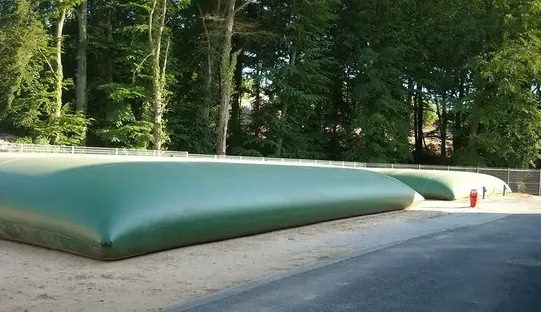
Flexible fire water storage tanks in Canada
30–2,500 m³ capacity | Frost-resistant to -30°C | Rapid installation | No open-water evaporation
Also known as water bladder tanks, flexible tanks are delivered folded to the project site and installed above ground on a suitable prepared surface.
They are particularly suitable where:
- no municipal fire hydrant system is available
- available fire water supply is insufficient
- the project is located in a remote area
- temporary fire water storage is required
- conventional steel or concrete tank construction is difficult
- transportation and installation costs need to be reduced
Typical applications include:
- Wildfire preparedness
- Mining operations
- Industrial facilities
- Rural and non-hydranted areas
- Forestry
- Battery Energy Storage Systems (BESS)
- Solar and wind farms
- Construction sites
- Warehouses and logistics centres
- Utilities and substations
- Agricultural properties
- Remote infrastructure
- Temporary fire protection
Planning a fire water storage project in Canada? Send us your location, required capacity and application for a project-specific quotation.
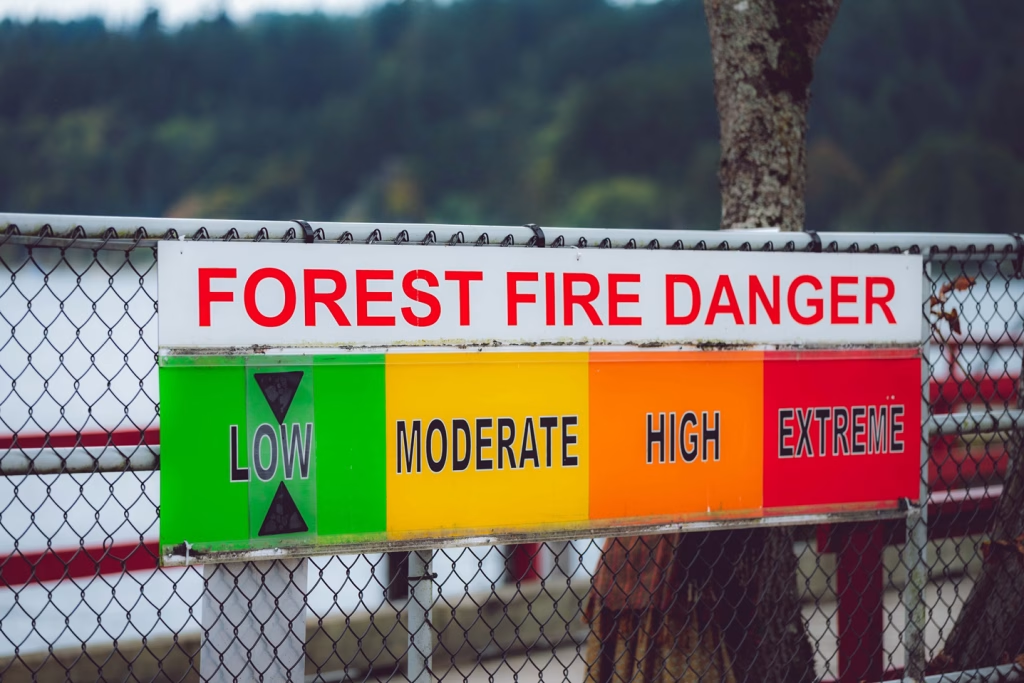 Forest Fire Proctection in Canada
What Is a Flexible Fire Water Storage Tank?
A flexible fire water storage tank is an enclosed flexible reservoir designed to store large quantities of water above ground.
Unlike a conventional steel, fibreglass or concrete tank, the empty flexible tank can be folded into a compact transport volume.
At the project site, it is unfolded, connected and filled with water.
Depending on the application, the system can be equipped with:
- Filling connections
- Suction connections
- Large-diameter outlets
- Valves
- Hoses
- Manifolds
- Pump connections
- Temporary piping
Flexible tanks can therefore provide either temporary or long-term water storage, depending on the application and project requirements.
Fire Water Tank Capacities
Our flexible water tanks are available in a wide range of capacities.
Typical fire water storage capacities include:
| Capacity | Water Volume |
|---|
| 30 m³ | 30,000 litres |
| 50 m³ | 50,000 litres |
| 100 m³ | 100,000 litres |
| 150 m³ | 150,000 litres |
| 200 m³ | 200,000 litres |
Larger tanks up to 2500 m³ are available.
Multiple tanks can also be interconnected to create modular fire water storage systems with significantly higher total capacities.
This allows the storage volume to be adapted to the specific project.
Fire Water Storage for Wildfire Preparedness
Wildfires are an important risk across many regions of Canada.
In rural and remote areas, firefighters may have limited access to municipal hydrants or high-capacity water infrastructure.
A strategically located wildfire water storage tank can provide an additional reserve of water closer to the area at risk.
Possible applications include:
- Rural communities
- Wildland-Urban Interface areas
- Farms
- Forestry operations
- Mining facilities
- Industrial sites
- Solar farms
- Wind farms
- Electrical substations
- Utility infrastructure
- Emergency staging areas
Flexible tanks can be installed at selected locations before or during periods of increased wildfire risk.
Fire Water Storage for Mining
Canada’s mining industry frequently operates in remote regions where conventional infrastructure is limited.
Flexible water tanks are particularly suitable for mining projects because the empty tank is compact to transport and does not require the transportation of a complete rigid tank structure.
Applications include:
- Open-pit mines
- Underground mines
- Mineral processing plants
- Exploration projects
- Mining camps
- Temporary workshops
- Remote maintenance facilities
- Construction infrastructure
Potential advantages include:
- Compact transportation
- Rapid deployment
- Large storage capacities
- Modular expansion
- Reduced civil works
- Suitability for remote sites
For northern mining operations, cold-weather requirements should be considered during system planning.
Fire Water Storage for Remote Industrial Sites
Many Canadian industrial, utility and infrastructure projects are located far from major municipal water networks.
At these sites, constructing a conventional tank can require extensive logistics involving:
- Steel
- Concrete
- Cranes
- Heavy equipment
- Construction crews
- Foundations
- Excavation
A flexible tank offers an alternative where project requirements permit its use.
Because the tank is transported folded, it can significantly simplify logistics to remote locations.
Typical applications include:
- Mining
- Energy
- Forestry
- Utilities
- Construction camps
- Remote warehouses
- Industrial plants
- Infrastructure projects
Rural Fire Water Storage
Many rural Canadian properties are not connected to high-capacity municipal fire hydrant networks.
They may rely on:
- Wells
- Ponds
- Lakes
- Rural water systems
- Tanker trucks
- Cisterns
- Dedicated storage tanks
A rural fire water storage tank allows water to be stored in advance and made available as part of a site-specific fire protection concept.
Potential applications include:
- Farms
- Agricultural facilities
- Rural warehouses
- Industrial sites
- Schools
- Commercial properties
- Residential developments
- Utility installations
The required volume and connection arrangement should be determined according to local project requirements.
Fire Water Storage in British Columbia
British Columbia is an important market for flexible water storage because of its combination of:
- Wildfire exposure
- Forestry
- Mining
- Mountainous terrain
- Remote communities
- Rural properties
- Utility projects
Flexible tanks can be used for wildfire preparedness, industrial water storage and temporary emergency water reserves.
Fire Water Storage in Alberta
Alberta combines major industrial and energy activity with extensive rural areas.
Typical applications include:
- Oil and gas sites
- Industrial facilities
- Mining
- Warehouses
- Renewable energy projects
- Agricultural sites
- Rural properties
- Utility infrastructure
- BESS installations
Flexible water tanks can provide supplementary or temporary storage where existing infrastructure is insufficient.
Fire Water Storage in Ontario
Flexible tanks can be used throughout Ontario for:
- Manufacturing
- Warehousing
- Data centres
- Mining
- Rural properties
- Energy projects
- Construction
- Utility infrastructure
They are particularly useful where additional storage capacity is required temporarily or where a conventional tank installation would involve substantial construction work.
Fire Water Storage for BESS Projects
Battery Energy Storage Systems are increasingly installed at renewable-energy and utility sites.
Depending on the project-specific fire protection strategy, substantial water storage may be required for emergency response.
Flexible tanks can provide a dedicated on-site water reserve for:
- Standalone BESS facilities
- Solar-plus-storage projects
- Substations
- Utility infrastructure
- Remote energy installations
Advantages can include:
- Large capacity
- Rapid installation
- Modular configuration
- Compact transportation
- Temporary or long-term use
The required firefighting water volume and complete system design must be determined by the responsible project professionals and authorities.
Fire Water Storage for Solar and Wind Farms
Solar and wind projects are frequently built in rural or remote regions.
Flexible tanks can provide stored water for:
- Solar farms
- Wind farms
- BESS installations
- Substations
- Renewable energy parks
- Remote electrical infrastructure
A modular system also allows additional tanks to be installed if future expansion requires more water storage.
Temporary Fire Water Storage
Flexible tanks are particularly attractive where the requirement is temporary.
Typical applications include:
- Construction projects
- Plant shutdowns
- Repairs
- Maintenance
- Replacement of existing tanks
- Infrastructure upgrades
- Emergency response
- Wildfire preparedness
- Temporary industrial operations
Once the requirement ends, the tank can be drained, folded and relocated.
Flexible Water Tank vs. Steel or Concrete Tank
Conventional large water storage tanks may require:
- Excavation
- Concrete foundations
- Structural construction
- Cranes
- Oversized transportation
- Long installation periods
A flexible tank is delivered folded and installed directly at the project site.
Key Advantages
Compact Transportation
A large-capacity flexible tank occupies comparatively little space when empty.
Fast Installation
Deployment can generally be completed much faster than construction of a conventional permanent tank.
Large Capacities
Individual tanks can store tens or hundreds of cubic metres of water.
Modular Design
Several tanks can be combined into one larger storage system.
Reduced Civil Works
Depending on site conditions, extensive foundations and excavation may not be required.
Suitable for Remote Sites
The compact transport volume is particularly valuable for Canadian mining, forestry and energy projects.
Cold-Climate Fire Water Storage
Canadian projects frequently have to operate under severe winter conditions.
The water storage system should therefore consider:
- Minimum ambient temperature
- Duration of freezing conditions
- Frozen valves
- Frozen piping
- Insulation
- Heating
- Frost protection
- Protected suction connections
- Snow and ice
- Winter access
For projects exposed to very low temperatures, the complete water-storage and withdrawal system must be planned accordingly.
The tank alone does not eliminate the risk of freezing.
How Much Fire Water Storage Is Required?
The required storage capacity depends on the project-specific fire protection concept.
Important factors include:
- Required water flow
- Required duration
- Building or facility type
- Hazard classification
- Existing water supply
- Refill capacity
- Fire department requirements
- Provincial requirements
- Municipal requirements
- Insurance requirements
A simplified calculation is:
Required Water Volume = Required Flow Rate × Required Duration
Example:
1,600 litres/minute × 120 minutes = 192,000 litres
This is only an example.
The actual required water volume must be determined for the specific project.
Fire Codes and Approval in Canada
Fire protection requirements in Canada depend on the province, territory, municipality and individual application.
The National Fire Code of Canada provides a national model-code framework, while applicable requirements are adopted and enforced at provincial, territorial and local levels.
A project may also be subject to:
- Provincial fire codes
- Building codes
- Municipal requirements
- Fire department requirements
- Engineering requirements
- Insurance requirements
Where a flexible tank is intended to form part of a regulated fire protection system, the proposed configuration should be reviewed by the responsible project professionals and authorities before installation.
We can provide technical tank information to support this review.
Frequently Asked Questions
What is a fire water storage tank?
A fire water storage tank stores a dedicated quantity of water that can be available for firefighting or emergency response.
What is a water bladder tank?
A water bladder tank is a flexible enclosed reservoir that can be transported folded and filled after installation.
What capacities are available?
Typical capacities include 30, 50, 100, 150 and 200 m³. Larger project-specific capacities are available.
Can several tanks be connected?
Yes. Multiple flexible tanks can be connected to create a larger modular storage system.
Are flexible tanks suitable for Canadian mining projects?
Yes. Their low transport volume and relatively simple installation make them particularly attractive for remote mining and industrial sites.
Can flexible tanks be used for wildfire preparedness?
They can provide strategically located water storage as part of an appropriate wildfire preparedness or emergency-response concept.
Can they be used during winter?
Yes, but freezing conditions must be considered in the design of the tank, valves, connections and piping system.
Are flexible fire water tanks automatically code compliant?
No. Acceptance depends on the complete system, project application and requirements of the relevant authority.
Can the tanks be used temporarily?
Yes. Mobile as well as temporary water storage is one of the main advantages of flexible tanks. They can also be used permantly for up to 20 years.
What information is needed for a quotation?
Please provide:
- Project location / postal code
- Required capacity
- Application
- Required flow rate, if known
- Available installation area
- Required connections
- Permanent or temporary use
- Minimum winter temperature
- Required delivery date
Fire Water Storage Tanks Across Canada
Flexible water storage solutions are available for projects throughout:
- British Columbia
- Alberta
- Saskatchewan
- Manitoba
- Ontario
- Quebec
- New Brunswick
- Nova Scotia
- Newfoundland and Labrador
- Prince Edward Island
- Yukon
- Northwest Territories
- Nunavut
From wildfire water storage in British Columbia to mining projects in northern Canada and industrial fire water storage in Ontario and Alberta, flexible tanks provide a scalable solution for demanding locations.
Request a Quote for a Fire Water Storage Tank in Canada
Do you need a fire water storage tank in Canada?
Send us:
1. Project location / postal code
2. Required capacity in litres or m³
3. Application
4. Required flow rate, if known
5. Required connections
6. Minimum winter temperature
7. Required delivery date
We will review your project and propose an appropriate flexible water storage configuration.
Request a quotation for your Canadian fire water storage project.